Swissport-Flynas Partnership and Implication on Ground Handling Market in Saudi Arabia
By Handzalah / Black Swan Research 10 September 2026, 8:15pm MYT


swissport-flynas partnership
The recent Swissport and Flynas partnership, announced on 7th September, 2026, really gave me something to think about when assessing the competitive landscape of ground handling in Saudi Arabia. After furthering Saudi’s liberalization of the airport operation market, new entrants come into Saudi to benefit from Saudi’s great geography as a hub for transport. Flynas announces that it signed a Sale and Purchase Agreement (SPA) and a Shareholders’ Agreement (SHA) to acquire 10% equity stake in Swissport Saudi Arabia for a total consideration of USD 13.33 million or approximately SAR 50 million. Swissport has stated that its market share in Saudi following this partnership will be 40%. This contradicts SGS’s stated market share of approximately 90%. How come? It is most likely because SGS and Swissport have different ways of calculating market share.
Flynas-Saudi ground services contract termination
The drawback to such freeing of markets can be seen in the example of the Swissport-Flynas partnership. Flynas had terminated their contract with Saudi Ground Services (SGS). This will have a substantial negative impact on revenues for the next coming years. The impact on revenue is expected to start on 6th March 2027. As much as around 11% of 2025’s revenues will be lost due to this termination. The contract’s revenue is expected to reach around SAR 306 million by end of year. As a way to mitigate some of the negative financial impact, SGS is working on increasing productivity and rationalizing expenses.
Now Swissport is ~10 years after launching their operations in Saudi with more than 6,000 aviation professionals and serves customers at 20 airports throughout the Kingdom of Saudi Arabia.
moving forward
Some questions that I had after pondering on the future of Saudi’s ground handling market:
A) Are airlines going to opt out of these former monopolies in ground handling?
B) What are some reasons airlines would switch from SGS to Swissport?
C) Is there going to be continued decline in these former ground handling monopolies such as SGS and SAL?
I will try to answer what I believe are the answer the the questions above.
A) Some airlines might opt out because of the growing amount of choices the customers now have after the liberalization of the airport operator market. Now customers get to choose from Swissport, SATS, SAL, and SGS.
B) To understand this question, you must understand the consumer’s hierarchy of preferences in the ground handling market. The consumer’s hierarchy of preferences is term coined by Drew Cohen of Speedwell Research which states that consumers have a list of key priorities for a product or service to fulfill in order for the consumer to go ahead with the purchase. In the case of ground handling I believe that the highest order priority is reliability and cost efficiency. Therefore, airlines like Flynas may switch due to better operating efficiency and reliability with Swissport. Additionally, ground handling costs are substantial to airliners, therefore, airliners may choose to reduce cost in order to achieve profitability.
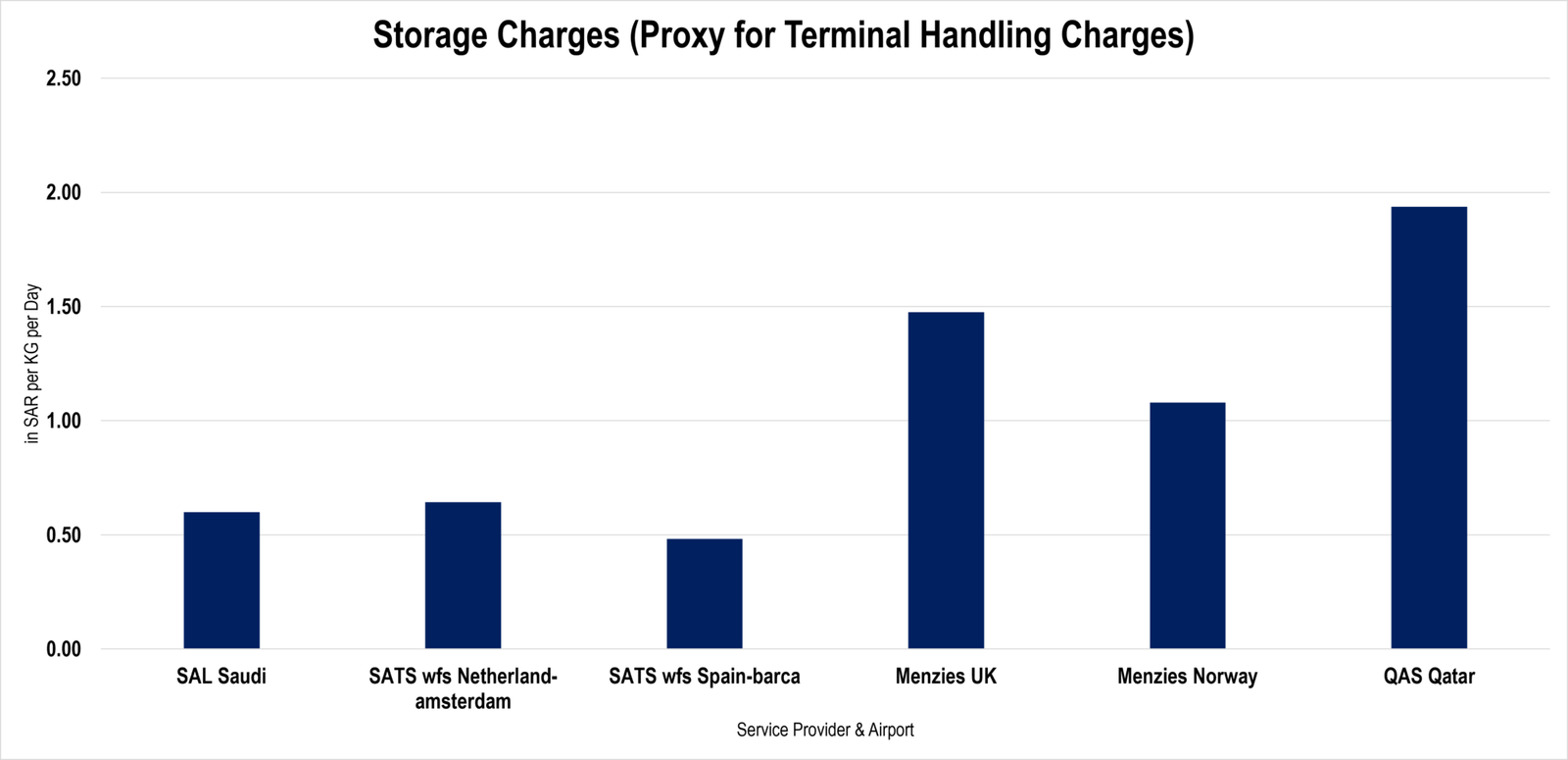
C) A company that used to have monopoly power can see a large decline in market share if they abused their market power by charging exuberant prices for their products and services. I have not gone through SGS and how they price their services relative to international standards. However, I have compared SAL’s price for its services (using a proxy) to other ground handlers around the world. This is easy because the terminal handling charges are public information. Figure 1.0 shows that if we take storage charges as a proxy for overall service charges, SAL is amongst the lowest. SAL has a slightly different business from SGS. SAL as of current only focuses on air cargo. And in my opinion it is a little more difficult for foreign competition to gain market share from SAL because the market share of air cargo ground handling is tied with infrastructure. This is because in order to increase revenue, ground handlers must increase their tons handled which is constrained by their terminal capacity. SAL and other service providers that have long-term concessions to operate in these terminals has a large economic moat to fend off competition.
Salman Ahmed from SGS says in Q2 FY2025 webcast “The cake size is getting bigger, so the market is expanding. Yes on an overall basis you might see a decline in market share. But it’s for everyone.” This further brings clarity to some doubt we may have in the market. If markets can grow fast enough with all these new airline contracts, all players in the ground handling market may win.
Please if you have insights on this topic please share in the comments or email me. Thank you.