Right Tail Capital: Summary of 4 Years of Fund Letters
By Handzalah / Black Swan Research 14 August 2026, 9:50am MYT

how i got to find right tail capital
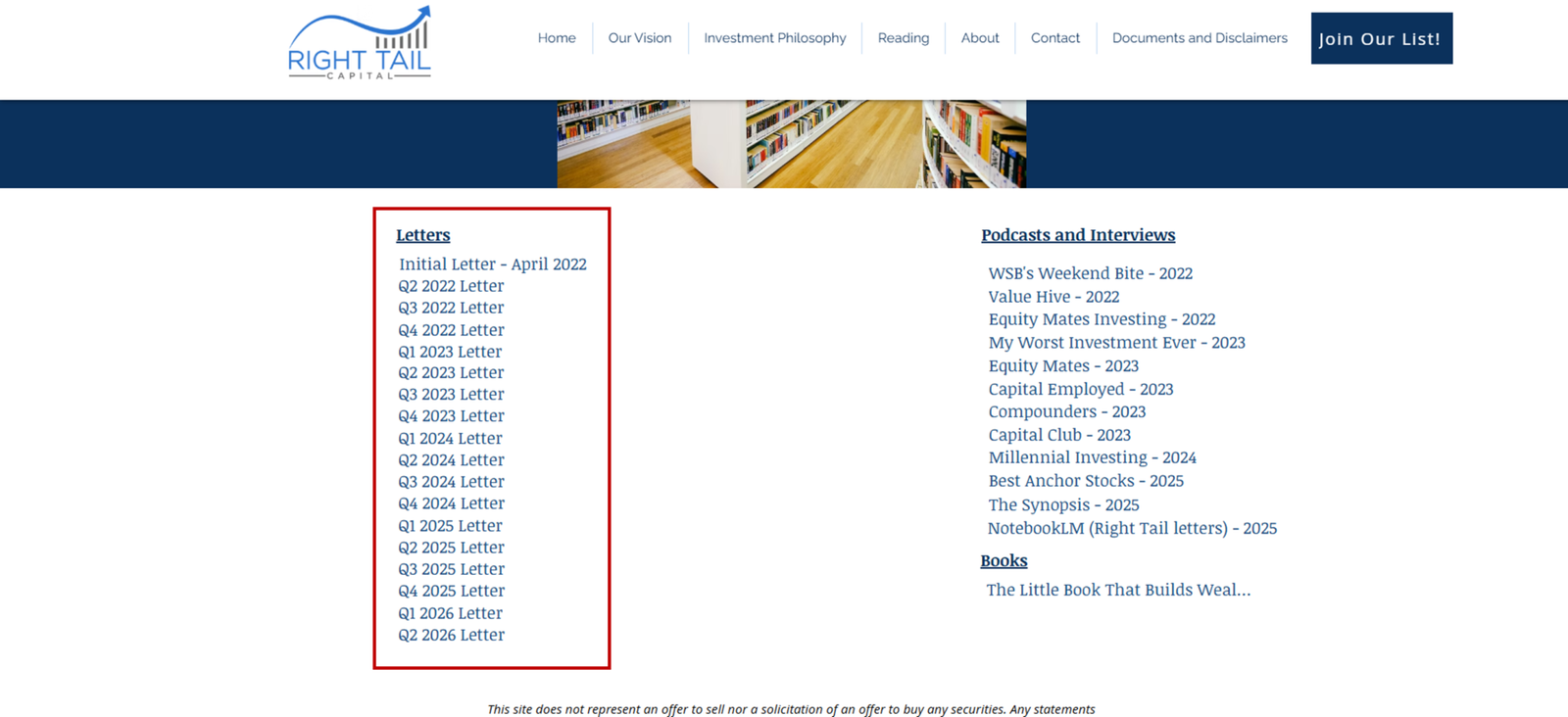
I first found the fund not too long ago. I read their Q1 2026 letter because it contained a company I was in the process of understanding. I was hooked by the fund manager’s views on how to create value for shareholders. I read through all their letters (inception 2022 to Q2 2026) within the span of a day. That was 66 pages of another fund’s 4 years of operation. I took a little breaks here and their to ponder a little on the letters. Right Tail Capital’s (RTC) inception date is close to when I started investing (2023). There were many instances where Jeremy Kokemor, the fund manager, mentions events that affected his portfolio, that I can reflect back from. Such events are like the tariff set by the US, AI software sell-off, and the US-Iran war that drove oil prices to the roof. Now it is not to say Jeremy looks at this events and take unnecessary action. He has the idea that one should not focus on the macroeconomics. But he would mention now and then to bring clarity to why some business valuations contracted. I love how Jeremy is able to display his thoughts on the letter in a concise manner. This is actually a very underappreciated skill. In this post I intend to share what I found interesting and what I found worth sharing from the 4 years worth of letters. More about the fund can be found in righttailcapital.com/about-5. Note that some sections of the notes will have my own input and thought process.
Companies mentioned
- Ferguson Enterprises Inc. (NYSE:FERG)
- Constellation Software Inc. (TSX:CSU)
- Dollar Tree, Inc. (NASDAQ:DLTR)
- Ross Stores, Inc. (NASDAQ:ROST)
- Lithia Motors, Inc. (NYSE:LAD)
- Asbury Automotive Group, Inc. (NYSE:ABG)
- NVR, Inc. (NYSE:NVR)
- The Charles Schwab Corporation (NYSE:SCHW)
- Boyd Group Services Inc. (TSX:BYD)
- CDW Corporation (NASDAQ:CDW)
- Insight Enterprises, Inc. (NASDAQ:NSIT)
- O’Reilly Automotive, Inc. (NASDAQ:ORLY)
- Copart, Inc. (NASDAQ:CPRT)
- People Incorporated (NASDAQ:PPLI)
- Charter Communications, Inc. (NASDAQ:CHTR)
- Norfolk Southern Corporation (NYSE:NSC)
- SS&C Technologies Holdings, Inc. (NASDAQ:SSNC)
- AutoZone, Inc. (NYSE:AZO)
- Advance Auto Parts, Inc. (NYSE:AAP)
- Alphabet Inc. (NASDAQ:GOOG/NASDAQ:GOOGL)
- Natural Resource Partners L.P. (NYSE:NRP)
- HCA Healthcare, Inc. (NYSE:HCA)
Books recommended
- One Buck at a Time: An Insider’s Account of How Dollar Tree Remade American Retail (Author: Macon Brock)
- What I Learned About Investing from Darwin (Author: Pulak Prasad)
- Working (Author: Robert Caro)
- The Gap and The Gain: The High Achievers’ Guide to Happiness, Confidence, and Success (Author: Dan Sullivan)
- The Inner Game of Tennis: The Classic Guide to Peak Performance (Author: W. Timothy Gallwey)
- Winning on Purpose: The Unbeatable Strategy of Loving Customers (Author: Fred Reicheld)
- Play Nice But Win: A CEO’s Journey from Founder to Leader (Authors: Michael Dell & James Kaplan)
- Last Man Standing: The Ascent of Jamie Dimon and JPMorgan Chase (Author: Duff McDonald)
Some notes and key takeaways
we are inherently myopic
Jeremy said that if you were to play an audio from one of Buffet’s annual meeting videos he would not be able to identify which year the meeting took place. He said the reason is that during the Q&A portion of the meeting, people would ask the same questions. It was centered around macroeconomics or other short-term related questions. Many times during the year, people would ask such questions. This just shows that many of us have a narrow and myopic view in the world of business.
Jeremy refined Bill Gates’s quote, “we overestimate what we can get done in two years and underestimate what we can get done in ten” to “many investors overweight today’s news and underweight what great companies can accomplish in five years.” This again reflects the inherent trait of humans in that we really struggle with identifying what actually lifts a business’s value over time. I saw that there was many investors that relate investing to sports like running. Jeremy loves to run in the rain. His running-investing analogy is that when running in the rain, people tend to focus on the rain (macroeconomics) rather than focusing on the run (the actual business).
Some points worth mentioning
- Don’t judge a book by its reviews similarly don’t judge a stock by what the crowd thinks
- Core theme of his companies is trying to delay or defy the gravity of capitalism (the gravity of capitalism essentially means that over time excess returns in a business would attract competition thereby lowering that excess returns)
- Uses Buffet’s $1 test to evaluate the value creation created by businesses through retained earnings (detailed section below)
- “Everybody’s got a different circle of competence. The important thing is not how big the circle is. The important thing is staying inside the circle.” -Warren Buffet, this quote best reflect Jeremy’s selection of businesses. He invested in many auto-related businesses which he understands more than the vast majority. Sticking to his circle of competence can lead to great results and this has been reflected by some of the auto-related businesses up many percentages from his initial investment in them.
- There is consolidation in the car dealership industry. From 30k dealership to 17k dealership. The changing landscape of the industry can show improving business economics similar to when Buffet invested in railways. The car dealership industry economics will likely not change as drastically as the railway industry did.
- Fund focuses on win-win relationship where all stakeholders benefit from each other
- Uses the letters as a means to reach out to people who are within the industry so that he can further understand the industry. This reminds me of when Buffet would advertise Berkshire as a buyer of businesses to whomever wanted Berkshire to take care of their business.
- Time is an important input for compounding wealth. My personal experience is that people overweight their returns that they got in the short-term, making claims like “look, I made in a day 4 times what EPF (Employees Provident Fund, Malaysia’s retirement plan) gives you in a year.” This suggests that he had a daily return of 24%, this is larger than the 6% that EPF offers on average per annum. However, is the return sustainable over the long-run? That is the key question. Because RM 1,000 invested with a yearly return of 20% will give you a RM 200 in profit (assuming that the return is not sustainable therefore only one year of investing). Whilst a RM 1,000 invested at 10% (after adjusting for inflation) but sustained throughout 10 years will leave you with RM 1,594 in profit. This truly shows that time is really the friend of the long-term investor.
- The fund is closely aligned with their partners with two main methods. Firstly, Jeremy and his wife is the largest contributor or investor in absolute dollar amount and is probably the largest in terms of percent of net worth. Second, the fee structure follows that of Buffet Partnership where they get zero management and have to at least achieve above the hurdle rate of 6% to get a performance fee split of 25% of returns in excess of the 6%.
- NVR is a home builder that Jeremy really likes. The reputation they have with developers remain to be an underappreciated aspect of the business. The many years of reputation makes NVR hard to replace which in of itself can be an economic moat. Using Buffet’s $1 dollar test, NVR shows us why they can compound shareholders wealth over long stretches of time. During the period of 2010 to 2023, NVR gained $16 billion in market capitalization whilst increasing retained earnings by $400 million. This means that they created value with their retained earnings over the decade. And this is shown in their share price increase from period 2013 to 2023, where the share price compounded at a CAGR of 21%. Jeremy believed that the housing market is undersupplied in 2023, when he wrote on NVR.
- After the passing of Charlie Munger, Jeremy wrote a few of his favorite quotes from Charlie Munger and saying that he was following Munger’s wisdom over the years
- “Charlie would say don’t avoid mistakes because they are inevitable.” -Jeremy Kokemor. This is important, although we want to have a low turnover portfolio, we must admit that we make mistakes and selling your investment might be better than letting it linger in your portfolio.
- Sold Charles Schwab in March 2023 because the investment thesis was slowly shifting and he did not want to put time and energy into untangling the mess. He would rather use that time and energy into finding the next Right Tail investment. The shows that with every decision there is an opportunity cost imbedded.
- Stresses on having great health and mind in order to bring the best service for his partners
- After running the mind is fresh
- Uses percentage of total employment in customer-facing fields as a measure on how much CDW Corporation focuses on enhancing their customer service
- Grew assets under management (AUM) from $3 million to $27 million in 3 years
- Culture compounds. He says that long-tenured employees and promote-from-within leadership creates sustainable durable edge that often is underappreciated.
- Noted that Jeff Bezos once remarked that he is more interested in thinking about what will not change over the next decade than what will
- AI is not a substitute for judgement.
1) does not meet management
2) does not assess the incentives
3) does not value corporate culture
4) does not develop conviction built over years of studying an industry
Buffet's $1 test
The sum of retained earnings within a specific period of time can be measured against how much that company increased in market value or market capitalization to reflect how well the company did in turning a dollar in retained earnings to a dollar or more in value created. This measure can tell you whether a company should give more in dividends or retain those earnings. If the ratio between market value created-to-total retained earnings is less than 1, this means the retained earnings destroyed value. Ideally, it should be higher than 1 to signify that retained earnings held by the company is worth more than if they were to distribute it in form of dividends. Here is an example.
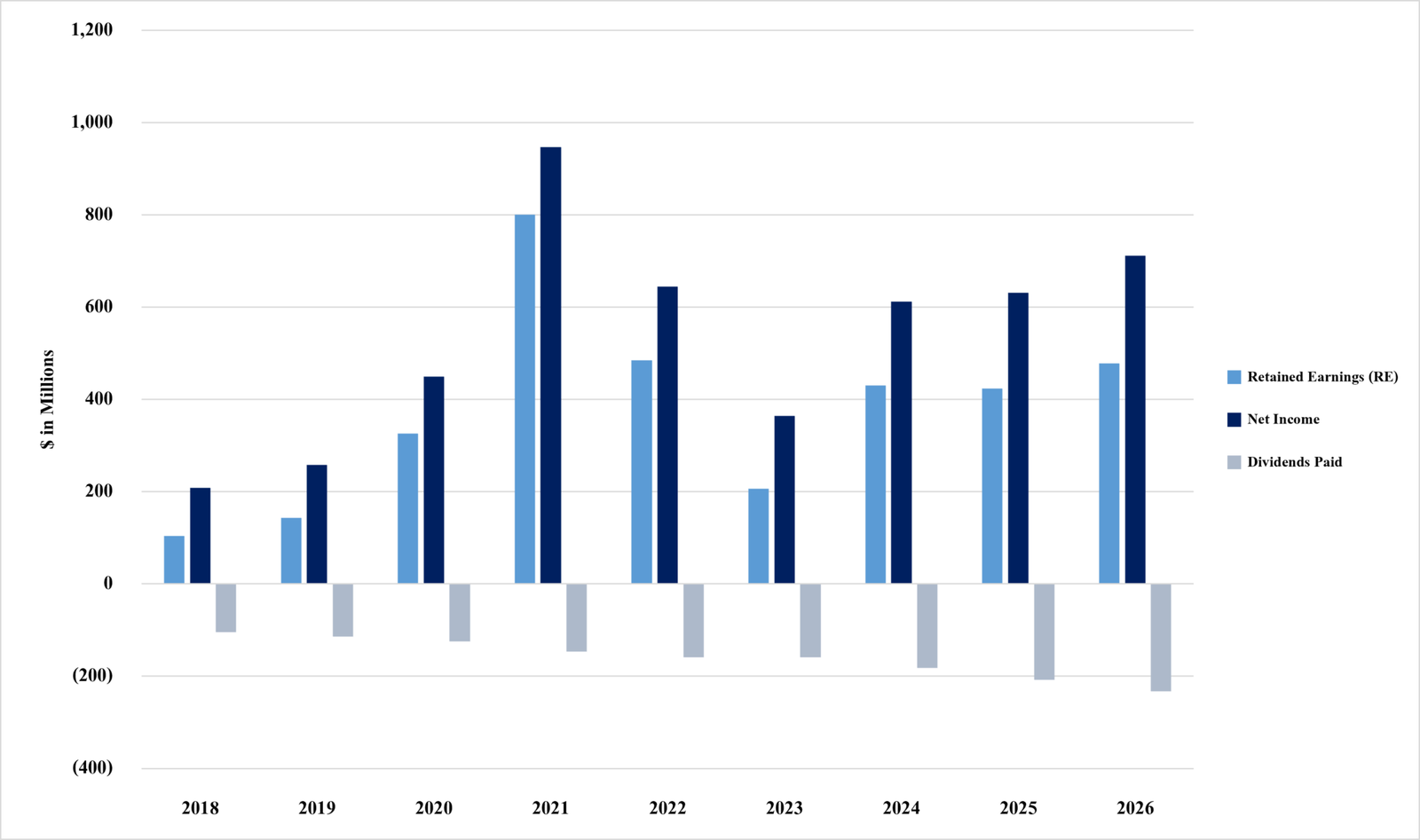
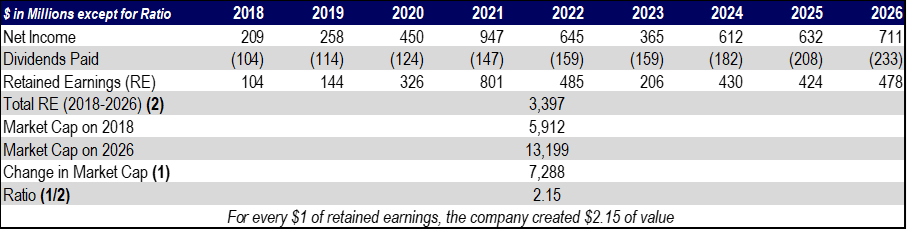
I took the fiscal period from 2018 to 2026 and used Logitech as an example. Their fiscal year ends on March that is why we have the data for 2026. To get the retained earnings, simply subtract dividends the company paid during the year from net income earned during the year. This retained earnings is what is kept within the company that allows the company to potentially create value through various ways. Some of the ways they can create value is by buying back shares if they are bought under their intrinsic value, investing in capital expenditures, and M&A. After subtracting the dividends from the net income, proceed by getting the sum of the retained earnings from 2018 through to 2026. Throughout the 9 years, Logitech retained $3.397 billion in earnings. Now, we want to know how much value is created therefore, we take the difference in market capitalization between the time period (2018-2026). In this case, Logitech created $7.288 billion in value during the 9-year period. Finally, take the change in market capitalization and divide it by total retained earnings. We get 2.15.
This shows that every $1 Logitech retained, $2.15 of value is created. Therefore, us as investors should be a little reluctant on Logitech distributing dividends. Of course, the next 10 years can be a different story for Logitech. They may not be able to turn a dollar of retained earnings into more than a dollar of value. But this is a great rule of thumb.